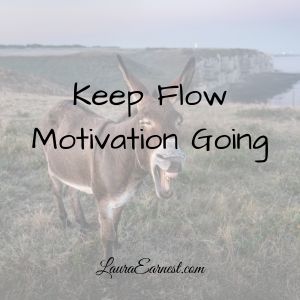
Many years ago, I followed an up-and-coming artist who produced some really beautiful yearly planning workbooks. She called flow state “riding a wild donkey” in that you just have to hang on and ride it to the end. It’s a great feeling, when everything is flowing and you just want to see it out. But then real life intervenes. So how can you keep flow motivation going when you don’t have the time or energy to ride the wild donkey?
Back in the Day…
There was a time in my life when holding on to flow state and seeing it through was not an issue. It was always amazing to me to be absorbed in something, finish it, and then sit back to see what had been created. It was always a ton…lots of things finished, ideas flowing effortlessly, and an adrenaline-infused woohoo at the end.
Of course, more often than not those sessions happened when I got my second wind, around 9 pm, and usually wrapped up in the wee small hours…and then I would have to snatch a few hours of sleep and go into work. Usually groggy and always unfocused and generally unproductive.
As I grew older this became something I was less and less willing to do, so many of my flow states were cut short. I would stop working suddenly. The next day I would find myself looking back with regret, as I struggled to get back into what I had been doing.
So I realized I had to find a way to keep that flow motivation going.
What Am I Doing In The Moment?
I am more often off task than I am on task. I will check in with myself from time to time to ask myself if I am doing what I intended or if I have gotten sucked into something else.
That’s not to say deviating isn’t bad; if I am off track I then ask myself if I am doing something that is worthwhile. Donkeys don’t come in one size and shape after all.
If I really need to focus, I use post it notes. I write what I am supposed to be doing (single or multiple tasks) and then keep that post it where I can see it. This method helps me get things done during my lunch hours while working from home, as well as keep me focused when I am writing.
I can also determine very quickly if I am in any state approaching flow-like conditions. If I am, I have trouble pulling my mind away from the task at hand, or have a bunch more ideas come to me.
Monitoring My State
No matter what flow state I am in, I have to monitor my physical state of being. I know that fatigue will derail me the fastest, as will the inability to concentrate.
Before I sit down to work on anything, I do a distraction audit. This is easier to do when I am at the computer, because I can look around and see the distractions. But I can also do it when I am doing things like cleaning something. My distractions there are things that need to be taken care of or moved elsewhere. My first step in tidying is to pull all the things that don’t belong in a space into a pile.
I make sure that I am taking breaks – getting up and moving around to ease the stiffness in my joints (cancer drug side effect). I make sure that I roll my neck and stretch my levator scapula to ease the tension in my upper back. I check my posture and make sure I am not hunched over. And I also make sure that I take a drink of water.
I am also determining the things I can eat to get the maximum output from my brain. There are foods that will sink my energy very quickly, and those that will allow me to have more energy for whatever it is that I am doing.
Paying attention to all these things gets me to the point where I can sustain a flow state for a longer period of time.
Monitoring The Next Activity
I haven’t had the luxury of unlimited time to do any sort of activity in many years. There is always something on my schedule.
Even in my days when I was taking advantage of the seemingly empty time at night, I was ignoring the next item – sleeping – and paying for it the next day with exhaustion.
While keeping sight of the next activity on the schedule would seem to be a barrier to getting into deep concentration, I find that it is the opposite. Knowing my limits allows me to stay in the groove.
Now, I will freely admit that I have to set an alarm on my phone if the next activity is not something on my calendar. I routinely set alarms for when I have to go make dinner, and when I need to get ready for bed. This is the only way I can pull myself out of deep concentration and make sure I move onto the next important but unscheduled-on-the-calendar activity.
Wrapping Up The Flow Session
This part is the key for me to get back into an activity once I need to wrap up. If I don’t make specific efforts to wrap up the flow before the task is done, then I will be unable to back to it without a significant effort. Sometimes I lose track of the item altogether. This is sad, because not only do I not remember what I was working so hard on, but I know that it will never come back.
When I need to pause a concentrated flow session for later, I take a low tech approach to it. I grab a sticky note and write down the following:
- The date/time
- What I was doing, what I was trying to accomplish
- What are the next steps
- What other ideas might play into this
Obviously, with a sticky note, I can’t go too far into detail. But I can write a few well-chosen words that will serve as a memory prompt.
I put these sticky notes inside my bullet journal front cover so I always know where to look.
Restarting Flow
Once I am ready to pick up the item again, I take a bit of time. I will take out a piece of paper, usually in my scribble notebook. I look at the sticky note, and based on what is written there, I flesh out any of the ideas on the item. If something pops into my head, I write that down as well.
Then I figure out what the next three things I need to do are. I make sure these things are specific and do-able in less than 10 minutes. This allows me to get back into the task with a series of small wins. In other words, “read through draft of article” is better than “write articles for July.”
This is 75% most likely to get me back into the task with a good shot at flow state. If I am having trouble getting back into it after completing the three items, I will make a list of three more and do those.
If I still can’t get back into it, I write up a sticky note (see above) and put it away for another time. I allow myself this grace when I simply don’t have the energy or desire to do something.
In Conclusion
I find that flow state can be extended by being aware of what I’m working on, monitoring my energy and physical state, keeping track of time constraints, and properly documenting my work when I need to stop. By writing detailed notes about where I am and where I’m going next, I can quickly pick up the thread later without losing momentum.
This approach has helped me maintain productivity despite the limitations of real life that prevent me from riding my wild donkey all the way to the finish line. Instead of lamenting interrupted flow, I’ve learned to harness it through preparation and documentation, making my creative process more sustainable in the long term.